ブックマーク  Registration to Yahoo! Bookmarks| Registration to Hatena bookmark | Clip this article!

SHIBUYA BUNKA SPECIAL

Shibuya Culture Tea ceremony "Let's work in Shibuya." What do you mean "to work in Shibuya" for you?
What is the tendency of people working in Shibuya?

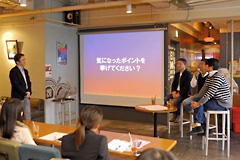
West:We conducted a questionnaire survey in advance, mainly for people gathering today and those working in Shibuya. In the second half I would like to think about "Working in Shibuya" based on the results of this questionnaire.

What is the commuting time to gender X generation · Shibuya?
What is your occupation?

West:When you check the profile of everyone who participates in this place, thirties are the most frequented people, the next will be the twenties and the forties. Majority live in 23 wards of Tokyo, occupations are "food and drink · food system" a lot, then "financial / real estate" "student", "IT system" "advertisement" "specialty store" "retail store" etc. There are relatively soft industries. Some commuting time is "less than 30 to 60 minutes" remarkable, and some people pass from "very long distance", "90 minutes or more and less than 120 minutes".

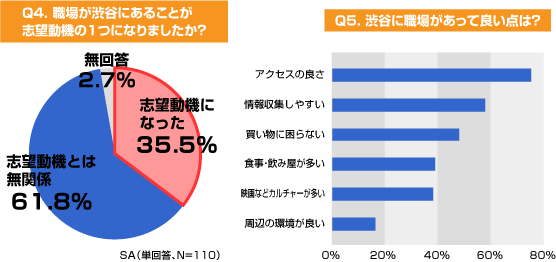
Have you become one of motivations to pursue that your workplace is in Shibuya? · What is the good point that there is a workplace in Shibuya?

West:Among them, I asked people in my workplace in Shibuya, 30% motivated me to choose a job that my workplace is in Shibuya. This is quite a lot. The reason is "convenient access", "easy to collect information" and so on.

What is the fashion of work? · What is the lunch situation in Shibuya?

West:Clothes for people working in Shibuya are 47.3% casual. The suit is one-third or less. Although I am rather casual if it is rather casual, as I go to Marunouchi occasionally it is full of suit people, I feel like awesome, I think I'm going to escape to Shibuya direction soon, but this is Shibuya's That is also a trend. 38.5% of the "lunch" circumstances worried about working everyday is 38.5% but actually adds "slightly unsatisfactory" "expensive" "low choice" actually exceeds 50%. It seems surprising that the lunch situation in Shibuya is not good. Please also do your best for the cafe company (laugh).

Kusumoto:Yes (lol)

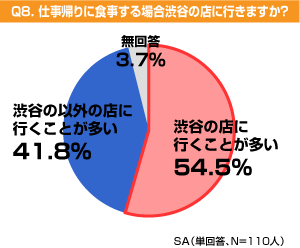
When going to work on the way to go to the shop in Shibuya?

West:Which shop do you go to for work after such work? There are quite a few people who will leave Shibuya and go somewhere when we get older like us, how do you guys? The answer is "to go to a shop in Shibuya" is 54.5%, the majority. "I often go to town other than Shibuya" is 48%. You can read the image that there are quite a few people who are escaping outside of Shibuya.

What do you think, when the workplace moves outside Shibuya? · Is it fun to work in Shibuya?
Shibuya X office circumstances

"When you push Shibuya, there are places where you want to ask for newness in different places"

West:When I asked the straight question "Do you enjoy working in Shibuya?", 90% of the respondents answered that "fun". After all, “working from fun” is a great motivation. It is also a very good trend for Shibuya. Currently, IT companies are coming back to Shibuya little by little, starting with Pia in Shibuya, and DNA moving their headquarters to Shibuya Hikarie. Mr. Nakamura, what kind of trend is seen in recent office relocation?

Nakamura:There are many people who choose the Shibuya area at the starting point. For example, the share office called "Co-lab" was originally in Sanbancho, but I could do it recently in Sendagaya. Even if it can be renewed, it is not in the middle of Shibuya station but in the surrounding area. On the other hand, there are examples that goes out of Shibuya, in that case, in that case it is shifting to the countryside at once rather than saying "Next Shinjuku" and "Next Roppongi". For example, Mr. Terai of NPO corporation KOMPOSITION (composition). Although he still leaves the office in Shibuya, he has started the project called "Matsizu Creative" with the concept of "Tokyo Tokoro", and now he is based in Matsudo, Chiba.

West:Do you have a tendency to want to ask for another "newness" if you make extreme in Shibuya?

Nakamura:It does not Maybe so.

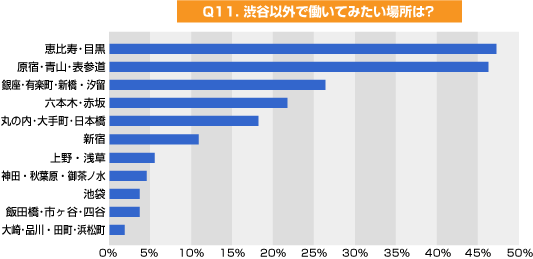
West:So I asked the questionnaire "Where would you like to work outside Shibuya?"

Where would you like to work outside Shibuya?

West:It is relatively close to Shibuya, Ebisu, Meguro, then Harajuku, Aoyama, Omotesando. Most people think that they want to stay in the Shibuya area. After that, it will be Ginza, Roppongi, Marunouchi, then Shinjuku.

What is it "to work in Shibuya"?

"I think that it is all work for" Who do you do ""

West:Everyone got a free answer so let's take a moment. First of all, a woman in her twenties has commented, "When I am in a place called information transmission base Shibuya, there are discoveries of various information and it is fun." Then, this is a little funny. "I can feed back my feeling of spiritual satisfaction that I can get from something good or bad from my chaos into the work," energy (a woman in her 30s). This is close to the image of Mr. Kusumoto.

Kusumoto:Yes. I am also in favor of chaos. For example, a hundred shops, Dogenzaka is somewhat clumsy around there. But that feeling creates culture. For example, now, Japan's unique fashion such as gothic lolly is touted in the world and is tied to the economy. But actually, it was probably a loose sock of cogal that was said to be "banned" from parents and teachers. That kind of ambiguity, danger, occasionalness, "chaos" is a trigger to create a culture by some opportunity, and we will proceed in the direction of "Allow this to be acceptable". Mr. Nakamura said earlier, but even if we are failing to start a business, it will lead to a mood like Shibuya if you can forgive something, but as I was young, I repeated various failures and that was the result I think that it will become subculture, become a culture, blossom as an alternative, and become proud of overseas. Since all the contexts are connected, this should be the case, this is not good, I think there is a possibility that things like the goodness of the city may be lost as a result. I think that I need something like the kindness of an adult to allow some sense of chaos as "Shibuya Lessiness".

West:I understand. Just free analysts say "I do not like the feeling of rough feeling" There are also people. And who is in the 40s who said "Where to work, not who is working, who to work with" is important. Then, a man in his 30s said, "I think that something is not prominent in Shibuya, but I think the overall balance is good." It was the same as last time in the tea ceremony of the last time, but Shibuya is not a city to say in a word, but that balance may be just right.

Kusumoto:I also think that it is all about work "I will do with who I am". Just to mention, in Shibuya, it seems like they are circulating like "people grow like that". Of course, not only in Shibuya but also in town and town should be the soil that nurtures its "richness", so that what each other's creativity cultivated from there should be "to do with who" as a result I hope to make it.

"Learn" "Play" "Work", Shibuya has many workplaces with three "

West:What did Mr. Yauchi feel from your questionnaire results?

Yanai:I always think "What is working, what is it?" When I was a child I came back from school, and he told me, "Please do not stay forever so please study soon." Although there is the word "learn well and play well," I think that the circle of "learning", the circle of "playing" and the three circles of "working" are slightly shifted but overlapping. In other words, learning happily, this is equal to playing. Working also overlaps with playing after all. I think that this is a totally different circle, I think it would be better not to do that kind of work. I think that it is the most interesting work where three things overlap, "to learn", "to play" and "to work". Looking at your questionnaire data, I thought that there is a lot of workplaces in Shibuya, which have these three elements. I think that many people are aware that the overlapping places are interesting compared to the past. I thought while watching the results of the questionnaire that Shibuya would become more like that in that sense.

Kusumoto:It is quite the same opinion. I think that it is "work = play = learning", so it also tells employees that it is a work style in Shibuya. I mentioned the keyword "easy going" a little while ago, but I do not mean that it is not badly done separately, I think that we want to live in the state that both play and work are combined. Conversely, I think that it is good to cultivate things like powerful enough to control myself.

"Shibuya has an effect like a magnet that gathers people like that"

West:Mr. Nakamura, how did you grasp the appearance of those who worked in Shibuya?

Nakamura:I felt that working in Shibuya could be "free" after all. It may be my personal way of thinking, but there are some existing values in other areas like Marunouchi, for example, and there is an impression that you are aiming for that value by working in that area. But Shibuya is everything. Freedom means "by myself", I wonder if there is an environment where you can work creative to be more interested in myself, "Is not it fun or interesting?" On the other hand, the charm of the place called Shibuya is actually a result, and I think that the root is the attraction of people gathered there. Attractive people are making attractive places. Shibuya may be like a magnet that collects people like those.

West:I feel that "Shibuya" when referring to "Working in Shibuya" points to a place, but maybe there is a nuance similar to "Working with a person in Shibuya", so to speak that a place and a person are so Perhaps it is Nearly Equal. Today I started from a place, but I feel that the last time I came back to people.

What would you like to ask a panelist?

"Think about it as a friend, rather than thinking as a" customer. "

West:Today young people are also looking at me, so I'm wondering if you can give me a question if you like. here you are

Questioner A:Shibuya is a place to accept various people, there is a story saying that it is a place to accumulate new culture more and more, I sympathized very much. In such a place, how can we measure the distance between the worker and the customer?

West:Well, is this Kusumoto's san?

Kusumoto:As a slightly rough opinion, I think that rather than thinking of customers as "customers", I think that they are "friends" and that we will make as many friends as possible. Of course the customer is a "customer". However, the customer is not "God". Be a friend. Because I am an important companion, I am thinking about what the person wants, and I will make a relationship with which my eyes meet. In that way I think that the community is born. So, we do not say "I will not be of you". "Hello" "Good evening" only. And then more to say, I think that it is better to say that it is better to say "Welcome back" than "Welcome" or "Hello". I would like to create a place where I can make such relationships.

Questioner A:Thank you very much.

"I am not done, the future is beginning"

West:Is there anything else?

Questioner B:I am a university 4 year student. Although I decided to get a job in August, when I looked back on job hunting activities, my feelings did not continue, I felt depressed, there were many things that motivation did not rise in many ways. What do you think is better to have more motivation in job hunting?

Nakamura:I think that general recruitment hiring is a very efficient way for both companies and job hunting students, but on the other hand there is a fear that I can not go ahead if I step out one of those paths. But even the company in Shibuya, when you actually meet someone employed in work department, there are quite a lot of people who do not do regular job hunting activities. For example, many people who have studied abroad, have been wandering, and many who are not doing regular jobs for many reasons, have become happy with each of them. I think that the part that does not come to be seen as a job hunting activity spreads to the outside world. So, when you talk more with people of various values, you can be relieved and I think whether you can end up with yourself as a result.

Kusumoto:Is it only a little better? Briefly, you'd better think that it is "a bad year." When the economy is good, there is a way to adopt such a situation. However, if the economy is in recession, you can think of a reversal. So I think it is a chance. Apart from venture companies, large enterprises are timing to change their own value with a spirit of venture, so probably business managers think that they are looking for such people, "Because of recession" Because there is no recession, if it is hit by job hunting with the idea of trying to catch things from a different point of view because it is a recession, people in the Human Resources Department may feel that "this child gets energetic! I would think so.

Yanai:I do not feel like taking fried feet, but you mentioned about job hunting activity, "I ended ...", did not you? But it is not over. The future is beginning. I think that working is the moment when I saw him as he aspirated, although he may come in from the place "my favorite job is this!", But I really think that anything is okay. What you can do is fun and what you do is have your own growth, and that depends on your feelings. So it's not the end, it's the start.

Finally "charm work in Shibuya"?

"Because information gathers, it becomes information dissemination"

West:This time I have been promoting with the theme of "Let's work in Shibuya", so I would like to ask you a little about "the merit of having a workplace in Shibuya" at the end. Kusumoto is raising the opinion that "creating a space where a community like a cafe spontaneously occurs".

Kusumoto:Because the information gathers, it becomes information dissemination. There is no information transmission base. You should think so. First of all, information accumulates and value accumulates, so it can transmit information as a result. That means that if the town called Shibuya becomes a place for information and value, it can be said that information dissemination in the exchange with the region is possible.

West:It's a point. It is really important to be able to disseminate information as it is a reservoir.

Kusumoto:Then, Confucius says, "I am going to graduate to 15," and "I stand up to thirty." I have not written for my twenties. In other words, I think that it is time to aspire to learning from 15 to 30. When thinking as "learning, work, play" that Mr. Yauchi just said "learning the way of learning" before this, it can be said that you can play until the age of 30, you can work extraordinarily and you can fail I think. I wonder if the city that can do such things is Shibuya. So, it is a young city, Shibuya, all ages.

"" ○ ○ な う ", Shibuya is the easiest to enter in that ○ ○"

West:Then from Mr. Nakamura, could you explain "The merit of having a work place in Shibuya as seen from the side of work?"

Nakamura:Net media such as Twitter and Yu-stream is developed, but when you say "○ ○ な う" on Twitter, for example, I feel that Shibuya is the easiest to enter in that part. After all, since it is impossible to meet if it is not a real place, it seems that "real place = city value" is increasing, so it seems that the city of Shibuya is strongly associated with social media. Regardless of how social media develops, there is a thought that it is "people" instead of "mechanisms" that makes it interesting after all.

West:It is strange to say again here, and finally the mechanism is a person, and I came back to people from places. The place called Shibuya is probably the place like that. So, the city called Shibuya, or something concrete building is not making interesting in Shibuya, but the people in Shibuya are interesting and creating a city with excitement. Shibuya may have a positive circulation that such people are further stimulated and produce interesting things. In that sense, when you look at the city of Shibuya, not to see the building, see the road, do not look at the shop, but observe the people there are fun of Shibuya, or work in Shibuya I felt once again that it might be interesting in things.

Nakamura:I agree. Shibuya seems like Zion, a human being, confronted with the movie "Matrix" to the very end, and I think that it is a place where you can be human being until the end. A place where you can think from yourself without existing values, where you can create various things creative. I thought that it would be such a thing to work in Shibuya.

"Working in Shibuya is the breath of the city of Shibuya"

West:Finally, Mr. Yanai, please.

Yanai:As I thought, working in Shibuya is still the "breath of the city called Shibuya". This is the most important reason why we moved to Shibuya.

West:Thank you everyone. I think that it is surprisingly few opportunities to discuss Shibuya as a theme of "work". Today, something abstract came out, there were many subjective views, and there were many parts that did not have a caption place, but in this way, it was said that "What does it mean to work in Shibuya?" I think that having a place to think with everyone was very meaningful. Well then, Shibuya Culture Tea ceremony Son ginseng, this is the end of today. Thank you very much.